Product Details
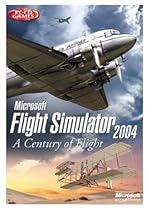 | Microsoft Flight Simulator 2004: A Century of Flight |
| List Price: | $19.99 |
| Price: | $19.50 & eligible for FREE Super Saver Shipping on orders over $25. Details |
Availability: Usually ships in 24 hours
Ships from and sold by SoftwareMI
50 new or used available from $6.93
Average customer review:

Product Description
ENG NA DVD BOX CDProduct Details
- Amazon Sales Rank: #1471 in Video Games
- Brand: Microsoft
- Model: G13-00079
- Released on: 2004-01-13
- ESRB Rating: Everyone
- Platforms: Windows 98, Windows 2000, Windows Me, Windows XP
- Number of items: 1
- Dimensions: 2.00 pounds
Features
- Dynamic weather system based on realistic atmospheric physics, with true three-dimensional clouds that form and dissipate
- Worldwide scenery with accurate 3D terrain and auto-gen objects that fill in the world with appropriate buildings and vegetation
- Enhanced interactive air traffic control (ATC), including traffic at all airports around the world
- Improved support for 3D graphics hardware acceleration in multiple windows and across multiple monitors
- For 1 or more players over LAN or Internet
Customer Reviews
Excellent flightsim - one of the best sims on the market
I am in love with aviation,
and therefore FS has become a part of my computing experience. I
purchased FS 1998, and though it was a tolerable product, I in no way
felt that it was a great simulation of flight. It just didn't have the
look and feel of flight. However, I was blown away by the progress made
in FS 2002. Though the clouds were not always realistic (modeling gave
them a two-dimension look that was disconcerting to say the least), I
thought that the overall experience was pretty good.
I saw FS 2004,
and I thought it was probably mot much of an improvement based on
reviews I had read. Let me just say that the first reviews I read were
wrong. FS 2004 is a major improvement over FS 2002, and it stands as a
all-time great product for aviation buffs like me.
Improvements:
1.
Weather: for the first time, flying on FS2004 simulates almost
perfectly the experience of actually flying. Clouds have the mist look
when you fly through them. The weather systems seem to generate
randomly, just as in the non-virtual world. Also, I like the weather
themes that can generate snow conditions, thunderstorms, and fair
weather with high altitude stratocumulus clouds. In short, the weather
is a fantastic approximation of reality. FS 2004 truly represents a
quantum leap in simulations. (although IL-2 still has the best clouds).
2.
ATC: FS2002 had the feel of real ATC but with some stupid problems. For
example, if you fly using IFR (instrument flight rules), and you failed
to reach your assigned altitude, the ATC would terminate their services
(what the heck is that about?). If you wanted to fly at a different
altitude you couldn't. Also, you couldn't change you IFR route, or
change from VFR (visual) to IFR in flight. FS2004 makes those changes.
For the first time you can change your altitude, you can change your
route, and you can switch between IFR and VFR. Yea!.
Another big
improvement is the ATC feel itself. For the first time, I actually feel
as though I am flying in a populated world. Lots of traffic at big
airports, just like in reality. Fly into San Francisco International,
and you may just see airplanes lined up to land. This is a big
improvement.
3. GPS: In FS2002, the GPS was very basic and
frustratingly difficult to use. It was based on a second generation
hand-held, and consequently, there were few features. The GPS in FS2004
has lots of features, is far easier to use because of a new interface
window that you can access in flight (see above), and you can switch to
terrain features and in-flight messages. It is a more realistic
approximation of a GPS device you would use in flight.
4. The
World: FS2004 adds signs at airport runways so you can see where your
going! It also adds more features to the world around you, such as
construction cranes, and different buildings not seen in previous models
of FS. Although I have noticed a new "Chick-fil-a" looking restaurant, I
can state definitively that no such place exists in San Diego, CA next
to the Lindbergh field runway. However, the scenery looks a lot better
than FS2002. Little details really add up and make flying in FS2004 much
better. The airports really look great. Denver International Airport
looks very realistic now, as does Seattle-Tacoma. ( I would rate more
but I just haven't had the chance to fly all over to world yet!)
5.
Computer: For some reason, FS2004 sees to run better on my machine than
did FS2002. No "slide shows" (bad frame rate) that I have found yet,
and the computer seems to run better with FS2002. I like this very much.
I haven't added to many third-party add-ons with FS2004 yet, but it
just seems to function better than does FS2002, so perhaps FS2002 had
some unresolved frame rate problems.
6. Open architecture: In
general, MSFS has open architecture which allows aviation geeks like me
to add-on scenery, and hundreds of planes, general, military and
specific airlines as well. Most of the products and downloads I have
found are excellent and work well with FS2004.
Complaints:
Given
how I feel about this product, I have very few complaints.
I wish
the ground textures were better. However, you can either download or
purchase products that have photo-realistic scenery, so you can really
fly though England of Southern California and really recognize the
ground.
Also, I wish the airports had more realistic aircraft in
them. Sometimes flying through LAX, I realize that Cessna would probably
not be at that airport. I have even taken off from major airports with
DC-3's lined up for takeoff - what is this the 1940's?
However, these
are minor problems, and overall Microsoft FS2004 is an excellent
product and is well worth a purchase.
The new state-of-the-art flight sim for PC My qualifications: More than
3000 hrs of real world flight time, Commercial, Instrument, Multi-Engine
and Flight Instructor certificates, and an incalculable amount of my
life spent "flying" every major flight sim ever made for the PC,
starting with the original MS Flight Simulator on an Apple IIe in 1983.
For whatever it's worth, folks, I'm an expert on this subject.
FS-2004
Century of Flight is the new state of the art, the new gold standard.
By itself, this software is worth going out and buying a new, hot PC
just so you can fly it.
If this is your first flight sim
experience, you'll have fun just doing loops and looking at the pretty
scenery.
But here's the truth: the more aviation experience you
have, the more you will appreciate this sim. Quite frankly, I can't
think of a single significant element of the real-world flying
experience that isn't precisely modeled and simulated in FS-2004.
Want
to climb in the 172 and practice NDB approaches down to minimums in
rain and a stiff crosswind? No problem, you can do that here. Want to
captain the 747 from San Francisco to Honolulu by moonlight? Consider it
done. Want to fly neck-straining aerobatics "in the box" over the
runway at Oshkosh in Patty Wagstaff's Extra 300? Start the engine and
go. Want to load up the DC-3 and fly "The Hump" to gain an appreciation
of true aviation heroism? Yep, you can do that too. With or without the
snowstorms and turbulence.
Quite frankly, if you can come up with
a non-combat flying scenario of any kind, you can almost certainly
experience something very close to it in FS-2004. This sim isn't just
fun, or accurate - it's realistic training and practice for the IFR
pilot.
Words simply can't express the depth, thoroughness,
accuracy and variety to be found in this sim. Everything happens in real
time and it's so accurate on my PC that I can get out my E6-B whizwheel
and do time, fuel and distance calculations while I'm "flying" and have
them work out almost exactly.
The more of a pilot you are, the
more this sim will give you. And no matter how many hours you have,
there is no pilot alive who won't benefit from the incredibly realistic
practice and training that this sim provides. If you rent a 172 now and
then, you'll be so much sharper in the real cockpit because of this sim.
And if you own your own airplane, you can practice things like
non-precision approaches, holding pattern entries, missed approach
procedures and engine failures to landing, all without burning a drop of
gas or putting your own airplane in jeopardy.
Here's what it
boils down to: In general aviation today, you either train and practice
with this sim, or you're behind the times and selling yourself short.
Get it.
Good Sim, But Remember the "Sim"
Part!
I have been using flight
simulators since MS Flight Simulator 4.0, and have more diverse
experience than only Microsoft's offering to call upon. While any
simulator can be made quite realistic with the latest hardware and
enough money, it is important to note that Microsoft's offering is no
different - you cannot, as they say, make a silk purse out of a pig's
ear. This means that if you're running an underpowered system, you will
not be able to run the simulation optimally.
Published system
requirements:
* Pentium 450 or greater processor
* 64 MB RAM for
98/Me, 128 MB RAM for 2000/XP
* 8 MB/3-D with DirectX 7.0 or later
videocard
* 1.8 GB hard drive space
My recommendation:
* P4
2.x GHz processor; the faster, the better
* 512MB RAM, with ideally
1GB under the hood
* 128MB / 256MB AGP video card that pushes TONS of
pixels - the more, the better
* At least 5GB free hard drive space -
You'll want to do a full install, and that comes in just under 3GB
(2.88GB, I think)
I run on:
* P4 3.0GHz processor
* 1GB RAM
*
Windows XP PRO (SP1)
* 256MB 8xAGP GeForce 5700 series NVidia video
card
* Sidewinder joystick (soon to go, thanks to some pedals and a
yoke I ordered!)
* On-board surround sound processor
The
software itself is practically infinitely extendable, with software and
hardware add-ons supported. A quick look around in the flightsim
community will support my assertion that the software is CHEAP compared
to what can be done to augment it. Add-on packages are available to
augment FS2004's admitidedly weak "ground mesh" mapping - flying through
Norway's waterways and coasts with the default scenery is nothing next
to the real thing, and pales in comparison to some of the add-on
packages (both for photo-texturing and mesh-building) out there. But of
course, these things cost money (sometimes), as does building and
maintaining a system that can fully take advantage of the software.
This
is a SIMULATOR, remember - a dozen years ago something like this with a
set of pedals and yoke would have been a BIG deal and far out of the
reach of the home consumer. Now, as the bar of admission lowers, it is
important to realize just how MANY numbers are being crunched every
second (most of those in graphics routines), and spec a system
appropriately. It might not be a multi-million dollar prospect to own
any longer, but to adaquately run the simulator and get something "real"
out of it, it is certainly not unheard of to run multi-head (throwing
many monitors onto a machine) for a partial panoramic view - but, of
course, realism comes at its price.
(same text as is found in my
review on the "tin box" version of FS2004)
My qualifications: More than
3000 hrs of real world flight time, Commercial, Instrument, Multi-Engine
and Flight Instructor certificates, and an incalculable amount of my
life spent "flying" every major flight sim ever made for the PC,
starting with the original MS Flight Simulator on an Apple IIe in 1983.
For whatever it's worth, folks, I'm an expert on this subject.
FS-2004
Century of Flight is the new state of the art, the new gold standard.
By itself, this software is worth going out and buying a new, hot PC
just so you can fly it.
If this is your first flight sim
experience, you'll have fun just doing loops and looking at the pretty
scenery.
But here's the truth: the more aviation experience you
have, the more you will appreciate this sim. Quite frankly, I can't
think of a single significant element of the real-world flying
experience that isn't precisely modeled and simulated in FS-2004.
Want
to climb in the 172 and practice NDB approaches down to minimums in
rain and a stiff crosswind? No problem, you can do that here. Want to
captain the 747 from San Francisco to Honolulu by moonlight? Consider it
done. Want to fly neck-straining aerobatics "in the box" over the
runway at Oshkosh in Patty Wagstaff's Extra 300? Start the engine and
go. Want to load up the DC-3 and fly "The Hump" to gain an appreciation
of true aviation heroism? Yep, you can do that too. With or without the
snowstorms and turbulence.
Quite frankly, if you can come up with
a non-combat flying scenario of any kind, you can almost certainly
experience something very close to it in FS-2004. This sim isn't just
fun, or accurate - it's realistic training and practice for the IFR
pilot.
Words simply can't express the depth, thoroughness,
accuracy and variety to be found in this sim. Everything happens in real
time and it's so accurate on my PC that I can get out my E6-B whizwheel
and do time, fuel and distance calculations while I'm "flying" and have
them work out almost exactly.
The more of a pilot you are, the
more this sim will give you. And no matter how many hours you have,
there is no pilot alive who won't benefit from the incredibly realistic
practice and training that this sim provides. If you rent a 172 now and
then, you'll be so much sharper in the real cockpit because of this sim.
And if you own your own airplane, you can practice things like
non-precision approaches, holding pattern entries, missed approach
procedures and engine failures to landing, all without burning a drop of
gas or putting your own airplane in jeopardy.
Here's what it
boils down to: In general aviation today, you either train and practice
with this sim, or you're behind the times and selling yourself short.
Get it.
Good Sim, But Remember the "Sim"
Part!
I have been using flight
simulators since MS Flight Simulator 4.0, and have more diverse
experience than only Microsoft's offering to call upon. While any
simulator can be made quite realistic with the latest hardware and
enough money, it is important to note that Microsoft's offering is no
different - you cannot, as they say, make a silk purse out of a pig's
ear. This means that if you're running an underpowered system, you will
not be able to run the simulation optimally.
Published system
requirements:
* Pentium 450 or greater processor
* 64 MB RAM for
98/Me, 128 MB RAM for 2000/XP
* 8 MB/3-D with DirectX 7.0 or later
videocard
* 1.8 GB hard drive space
My recommendation:
* P4
2.x GHz processor; the faster, the better
* 512MB RAM, with ideally
1GB under the hood
* 128MB / 256MB AGP video card that pushes TONS of
pixels - the more, the better
* At least 5GB free hard drive space -
You'll want to do a full install, and that comes in just under 3GB
(2.88GB, I think)
I run on:
* P4 3.0GHz processor
* 1GB RAM
*
Windows XP PRO (SP1)
* 256MB 8xAGP GeForce 5700 series NVidia video
card
* Sidewinder joystick (soon to go, thanks to some pedals and a
yoke I ordered!)
* On-board surround sound processor
The
software itself is practically infinitely extendable, with software and
hardware add-ons supported. A quick look around in the flightsim
community will support my assertion that the software is CHEAP compared
to what can be done to augment it. Add-on packages are available to
augment FS2004's admitidedly weak "ground mesh" mapping - flying through
Norway's waterways and coasts with the default scenery is nothing next
to the real thing, and pales in comparison to some of the add-on
packages (both for photo-texturing and mesh-building) out there. But of
course, these things cost money (sometimes), as does building and
maintaining a system that can fully take advantage of the software.
This
is a SIMULATOR, remember - a dozen years ago something like this with a
set of pedals and yoke would have been a BIG deal and far out of the
reach of the home consumer. Now, as the bar of admission lowers, it is
important to realize just how MANY numbers are being crunched every
second (most of those in graphics routines), and spec a system
appropriately. It might not be a multi-million dollar prospect to own
any longer, but to adaquately run the simulator and get something "real"
out of it, it is certainly not unheard of to run multi-head (throwing
many monitors onto a machine) for a partial panoramic view - but, of
course, realism comes at its price.
(same text as is found in my
review on the "tin box" version of FS2004)
No comments:
Post a Comment