Product Details
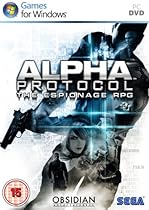 | Alpha Protocol |
| List Price: | $39.99 |
| Price: | $14.99 & eligible for FREE Super Saver Shipping on orders over $25. Details |
Availability: Usually ships in 24 hours
Ships from and sold by Best Game Deals
72 new or used available from $7.95
Average customer review:

Product Description
The year is 2009. Hundreds of innocent passengers and crew are killed after a commercial airliner is shot down over Eastern Europe. The culprit? A high-tech U.S. defense missile which had somehow fallen into the wrong hands. As government agent Michael Thorton, you have been chosen to find those responsible and bring them to justice. Become the spy of your choosing in a modern-day conspiracy plot. As you progress, decide how to develop abilities such as devastating physical combat moves, customization of your weaponry, and the use of ingenious gadgets and traps. Stay vigilant though – the cast of Alpha Protocol will react intelligently to your every move, resulting in the most exciting and unpredictable role-playing experience ever created.Product Details
- Amazon Sales Rank: #2048 in Video Games
- Brand: Sega
- Model: 85228
- Released on: 2010-06-01
- ESRB Rating: Mature
- Platforms: Windows XP, Windows Vista
- Format: CD-ROM
- Number of items: 1
- Dimensions: .40 pounds
Features
- Choose your words and actions carefully in a living, reactive role-playing world. Experience the “ripple effect” as encounters with your allies and enemies change relationships, reveal storylines, and unlock new missions.
- Mold Thorton into the secret agent you want to become with lethal close-combat techniques, marksmanship abilities, spy gadgets, and much more.
- Access an arsenal of weapons and customize their many add-ons to create the perfect weapon load out.
- Form relationships via dialogue and action choices within an intriguing cast of allies and enemies to get data for missions, new weapons and more. Remember who to trust and decide when to trust them …
- The game reacts to every decision you make. Will you let a terrorist escape to follow a lead, or eliminate targets against the mission agenda? With no right or wrong choices, every player can create their own storyline and ending.
Editorial Reviews
Amazon.com Product
Description
The year is 2009. Worldwide political tensions are
at a breaking point when a commercial airliner is shot down by a U.S.
missile over Eastern Europe, killing all aboard. The U.S. government
claims no involvement, and dispatches Agent Michael Thorton to
investigate and bring those responsible to justice. As the first modern
day spy role-playing game, Alpha Protocol offers unprecedented control
over the development of Thorton’s abilities and his interactions with
other characters. Upgrade skills such as physical combat, weapons
mastery, cutting-edge technology and even seduction as you grow in
experience and complete missions.

|

|


| Synopsis
In the near future, worldwide political tensions are at a breaking
point when a commercial airliner is shot down by a U.S. missile over
Eastern Europe, killing all aboard. The U.S. government claims no
involvement, and dispatches Agent Michael Thorton to investigate and
bring those responsible to justice.
As the first modern day spy
role-playing game, Alpha Protocol offers unprecedented control over the
development of Thorton's abilities and his interactions with other
characters. Upgrade skills such as physical combat, weapons mastery,
cutting-edge technology and even seduction as you grow in experience and
complete missions.
Key Game Features:
|
Customer Reviews
The Professional Reviews are Right, but Alpha Protocol is Still a Hit for RPG Lovers The thing with professional
reviews is that they are written for everyone, for the "mainstream" if
you like. The score at the end reflects what the average Joe might think
of the game, but the text is meant to key you in on what your
particular brand of video game enjoyment might get out of it, though
they rarely accomplish this.
So let me tell you about Alpha
Protocol from a pure RPG standpoint, from a fan of other real-time
stat-based PC RPG games like Deus Ex or Morrowind.
Alpha Protocol
rocks!
I know what you're thinking, "that can't be true, look at
the reviews!" Well, we talked about who those reviews are aimed at,
didn't we? Alpha Protocol is not aimed at those people. AP (as I will
now call it) is surprisingly aimed at classic RPG gamers who are now a
niche and do not control the industry... unlike Bethesda, who changed
The Elder Scrolls into real-time hack and slashing based on player
skill, Obsidian has made a shooter-RPG that is completely stat-based.
This throws off a lot of reviewers, as they all complain about "clunky"
aiming, "bad" stealth and cover and other such things. The thing is:
aiming is stat-based. If you have no points in assault rifles but you
keep using them, you are going to miss every time. If you put a ton of
points into pistols then in no time you are a one-shot death machine.
For instance, not only does putting points into pistols enhance basic
accuracy, meaning where you put the target is where the bullet goes, but
it also gives you the ability to aim from cover, which when playing
stealth is essential. Speaking of stealth, people say it does not work
but it does. When you put points into it you get enemy arrows, telling
you where they are and which way they are looking, along with cloaking.
You can also buy stealth suits and camouflage from the store, which
makes you even harder to spot. With a maxed-out pistol and stealth
character you can easily go through every mission never being spotted
and one-shot killing all the guards safely from cover. It's awesome.
Which
is not to say the game feels perfectly polished, it does not, it has
that old Obsidian rough feel to it. It's not nearly as bad as people
make it out to be though, and through my entire play-through I never had
any significant bugs or anything. The main reason it feels rough is
because the graphics are about 3 years old and the animations are poor.
Also, the AI can behave buggy at time, but as a stealth character I
honestly never saw them do anything really crazy... maybe because they
were dead before they left their patrol route. PC controls seem fine
too, not sure what the complaints are there... standard WASD shooter
controls. There is some annoying mouse smoothing, but you can disable it
and the game feels smooth and responsive. I think most of the "clunky"
and "buggy" complaints come from people who expect a head-shot to be a
head-shot no matter their stats, which is just ignoring the kind of game
they are playing. If you watch professional reviews of the game on
Gamespot, IGN or Gametrailers you can see this repeatedly come up as a
negative, even though it's true to the RPG genre and classics like Deus
Ex and Fallout 3 did the same thing.
The main thing I disliked
about the gameplay was the mini-games littered throughout. Gone are the
days when you could just pass a computer skill-check and access the
files, now you need to play a stupid mini-game no one likes in every
RPG. AP's are no better or worse than any other game's in my experience,
though they may be more frequent. The only one that is a bit rough is
hacking, but I don't think that has anything to do with consoles as some
reviews suggest, it's just an annoying mini-game period. The good news
is you can get special gloves which give you more time on all the
mini-games, so it's not so bad after the first mission or two. The only
other real issue I have with the game is lack of quick-save, but
honestly I believe this was done to encourage you to live with the
consequences of your actions. Similar to AP's dialogue system, which
forces you to make a quick response, the game often forces you to make a
quick mission decision... the auto-save is always quick to record your
actions, making your decisions weighty and without being able to be
scrubbed. Flubbed that line with that girl? Well, you have to deal with
the fact she likes you less.
In addition to the gameplay there is
also, of course, a story. As an RPG AP focuses on choice and
consequence and does a good job of it, plus the game auto-saves after
decisions meaning it's tough to just load the game up from before and
make a different choice. You'll still likely pick one kind of character
and stick with it, a joker, a serious man, a violent crazy... the
results of these choices are more impacting than in most similar RPGs
though. In Mass Effect for instance your decisions seems to effect
cutscenes later in the game, but not actual gameplay. In AP, this is
changed, and it reminds me of the classic Morrowind Thieve's and
Fighter's guild quest-lines where you had to side with one or the other
and that was that... in AP, you often take sides, and your missions
later in the game are severely effected by it.
So... choice and
consequence, stat-based action that doesn't dumb it down and amazing
Splinter Cell style stealth. That is what you get with Alpha Protocol.
If you want the next extremely polished AAA console shooter that cost
100 million dollars to make then look elsewhere, but if you fondly
remember games like Deus Ex, which made you think about your character
build and rely on more than your shooter skills, and gave you endless
choice and consequence in the story, and you can live with some lack of
polish... well, Alpha Protocol is for you, as it was for me, and I
suggest a purchase.
Fun, but needs
polish
I'm on my second playthrough,
and it's still quite fun as the choices tend to be more evident than in
other games that offer choices.
While I've encountered bugs and the
oft-mentioned control issues, there's nothing 'game-breaking' or
something I can't get around.
The dialogue, for the most part, is
well written (some bits are kinda corny and cliche, but I guess that's
part of the genre).
The characters are quite interesting, but not as
'engaging' as, say, those from Dragon Age or this other game that I'm
reminded of at times by AP, TLJ:Dreamfall (another good game, IMHO, that
just needed more polish). Perhaps more time (in-game) to develop each
character would have made them more 'effective'.
Gameplay is ok.
It's
not a straight out shooter (tho' I kinda played it as such in my first
playthrough: wearing lots of armor + assault rifle + endurance
skills/bonuses = lots of leeway in terms of combat).
How quickly you
'aim' (i.e., critical, I think), for example, is dependent on how high
your skill for a certain weapon. Plus there are special abilities that
allow your character to pull off stuff like multiple aimed shots w/ a
pistol within a short span of 'slowed time'.
I was actually hoping to
steer clear of the stealth aspects, but found that rather amusing,
too...and ended up playing a stealth-oriented character in my second
run.
There are times when it can get, annoying tho': the mouse
'skipping' when looking around, moving into and out of cover feels
clunky at times (esp. if you're in a hurry to get into melee). I've read
somewhere that there are .ini fixes for some issues, such as the one
for the mouse, I think, but I haven't tried them yet.
Complaints:
other than control and interface polishing (e.g., the mouse scroll when
viewing the PDA and E-mail/Shop could have been better), the game felt a
bit short (I'm almost done w/ my second playthrough, and I think I was
pretty thorough), when compared to another recent RPG, Dragon Age (my
first playthrough for Alpha Protocol must have taken around 20 hours,
while my first run of DA:O took more than 100 hours)...I guess I was
kinda enjoying it so I wanted it to be just wee bit more longer (like,
say, another 10-30 hours? :P )
Oh, and the AI can be a bit wonky at
times.
IMHO, it's a good game and I'm glad I got it. Those who
are unsure, tho', may want to wait a bit until the first patch comes
out.
A Game for RPG Fans, Shooter Fans
Not so Much
Alpha Protocol is the new
The thing with professional
reviews is that they are written for everyone, for the "mainstream" if
you like. The score at the end reflects what the average Joe might think
of the game, but the text is meant to key you in on what your
particular brand of video game enjoyment might get out of it, though
they rarely accomplish this.
So let me tell you about Alpha
Protocol from a pure RPG standpoint, from a fan of other real-time
stat-based PC RPG games like Deus Ex or Morrowind.
Alpha Protocol
rocks!
I know what you're thinking, "that can't be true, look at
the reviews!" Well, we talked about who those reviews are aimed at,
didn't we? Alpha Protocol is not aimed at those people. AP (as I will
now call it) is surprisingly aimed at classic RPG gamers who are now a
niche and do not control the industry... unlike Bethesda, who changed
The Elder Scrolls into real-time hack and slashing based on player
skill, Obsidian has made a shooter-RPG that is completely stat-based.
This throws off a lot of reviewers, as they all complain about "clunky"
aiming, "bad" stealth and cover and other such things. The thing is:
aiming is stat-based. If you have no points in assault rifles but you
keep using them, you are going to miss every time. If you put a ton of
points into pistols then in no time you are a one-shot death machine.
For instance, not only does putting points into pistols enhance basic
accuracy, meaning where you put the target is where the bullet goes, but
it also gives you the ability to aim from cover, which when playing
stealth is essential. Speaking of stealth, people say it does not work
but it does. When you put points into it you get enemy arrows, telling
you where they are and which way they are looking, along with cloaking.
You can also buy stealth suits and camouflage from the store, which
makes you even harder to spot. With a maxed-out pistol and stealth
character you can easily go through every mission never being spotted
and one-shot killing all the guards safely from cover. It's awesome.
Which
is not to say the game feels perfectly polished, it does not, it has
that old Obsidian rough feel to it. It's not nearly as bad as people
make it out to be though, and through my entire play-through I never had
any significant bugs or anything. The main reason it feels rough is
because the graphics are about 3 years old and the animations are poor.
Also, the AI can behave buggy at time, but as a stealth character I
honestly never saw them do anything really crazy... maybe because they
were dead before they left their patrol route. PC controls seem fine
too, not sure what the complaints are there... standard WASD shooter
controls. There is some annoying mouse smoothing, but you can disable it
and the game feels smooth and responsive. I think most of the "clunky"
and "buggy" complaints come from people who expect a head-shot to be a
head-shot no matter their stats, which is just ignoring the kind of game
they are playing. If you watch professional reviews of the game on
Gamespot, IGN or Gametrailers you can see this repeatedly come up as a
negative, even though it's true to the RPG genre and classics like Deus
Ex and Fallout 3 did the same thing.
The main thing I disliked
about the gameplay was the mini-games littered throughout. Gone are the
days when you could just pass a computer skill-check and access the
files, now you need to play a stupid mini-game no one likes in every
RPG. AP's are no better or worse than any other game's in my experience,
though they may be more frequent. The only one that is a bit rough is
hacking, but I don't think that has anything to do with consoles as some
reviews suggest, it's just an annoying mini-game period. The good news
is you can get special gloves which give you more time on all the
mini-games, so it's not so bad after the first mission or two. The only
other real issue I have with the game is lack of quick-save, but
honestly I believe this was done to encourage you to live with the
consequences of your actions. Similar to AP's dialogue system, which
forces you to make a quick response, the game often forces you to make a
quick mission decision... the auto-save is always quick to record your
actions, making your decisions weighty and without being able to be
scrubbed. Flubbed that line with that girl? Well, you have to deal with
the fact she likes you less.
In addition to the gameplay there is
also, of course, a story. As an RPG AP focuses on choice and
consequence and does a good job of it, plus the game auto-saves after
decisions meaning it's tough to just load the game up from before and
make a different choice. You'll still likely pick one kind of character
and stick with it, a joker, a serious man, a violent crazy... the
results of these choices are more impacting than in most similar RPGs
though. In Mass Effect for instance your decisions seems to effect
cutscenes later in the game, but not actual gameplay. In AP, this is
changed, and it reminds me of the classic Morrowind Thieve's and
Fighter's guild quest-lines where you had to side with one or the other
and that was that... in AP, you often take sides, and your missions
later in the game are severely effected by it.
So... choice and
consequence, stat-based action that doesn't dumb it down and amazing
Splinter Cell style stealth. That is what you get with Alpha Protocol.
If you want the next extremely polished AAA console shooter that cost
100 million dollars to make then look elsewhere, but if you fondly
remember games like Deus Ex, which made you think about your character
build and rely on more than your shooter skills, and gave you endless
choice and consequence in the story, and you can live with some lack of
polish... well, Alpha Protocol is for you, as it was for me, and I
suggest a purchase.
Fun, but needs
polish
I'm on my second playthrough,
and it's still quite fun as the choices tend to be more evident than in
other games that offer choices.
While I've encountered bugs and the
oft-mentioned control issues, there's nothing 'game-breaking' or
something I can't get around.
The dialogue, for the most part, is
well written (some bits are kinda corny and cliche, but I guess that's
part of the genre).
The characters are quite interesting, but not as
'engaging' as, say, those from Dragon Age or this other game that I'm
reminded of at times by AP, TLJ:Dreamfall (another good game, IMHO, that
just needed more polish). Perhaps more time (in-game) to develop each
character would have made them more 'effective'.
Gameplay is ok.
It's
not a straight out shooter (tho' I kinda played it as such in my first
playthrough: wearing lots of armor + assault rifle + endurance
skills/bonuses = lots of leeway in terms of combat).
How quickly you
'aim' (i.e., critical, I think), for example, is dependent on how high
your skill for a certain weapon. Plus there are special abilities that
allow your character to pull off stuff like multiple aimed shots w/ a
pistol within a short span of 'slowed time'.
I was actually hoping to
steer clear of the stealth aspects, but found that rather amusing,
too...and ended up playing a stealth-oriented character in my second
run.
There are times when it can get, annoying tho': the mouse
'skipping' when looking around, moving into and out of cover feels
clunky at times (esp. if you're in a hurry to get into melee). I've read
somewhere that there are .ini fixes for some issues, such as the one
for the mouse, I think, but I haven't tried them yet.
Complaints:
other than control and interface polishing (e.g., the mouse scroll when
viewing the PDA and E-mail/Shop could have been better), the game felt a
bit short (I'm almost done w/ my second playthrough, and I think I was
pretty thorough), when compared to another recent RPG, Dragon Age (my
first playthrough for Alpha Protocol must have taken around 20 hours,
while my first run of DA:O took more than 100 hours)...I guess I was
kinda enjoying it so I wanted it to be just wee bit more longer (like,
say, another 10-30 hours? :P )
Oh, and the AI can be a bit wonky at
times.
IMHO, it's a good game and I'm glad I got it. Those who
are unsure, tho', may want to wait a bit until the first patch comes
out.
A Game for RPG Fans, Shooter Fans
Not so Much
Alpha Protocol is the new espionage RPG from Obsidian Entertainment. This game has had an
interesting development cycle that started almost four years ago and has
been sitting on a shelf, finished, for over six months. Obsidian should
sound familiar to RPG (Role Playing Game) fans in particular. Prior to
becoming Obsidian, many of the key people worked for Black Isle Studios.
That company created some of the highest regarded RPG's such as
Planescape: Torment, Icewind Dale, and Fallout. They also worked with
BioWare on Baldur's Gate. Now, Obsidian has finished a new game in an
area of the RPG genre none have yet tried.
Story: This is the
meat of Alpha Protocol, and you can send the story down varying paths
based on what you choose during the game. The game allows you to
drastically alter how the story progresses, however, the backbone of it
remains the same. The game is set in recent times, a terrorist as
acquired cutting-edge missile technology and brought down a commercial
aircraft. You, Mike Thorton, have been selected to join Alpha Protocol
to put a stop to them. Alpha Protocol is a super-secret government
organization where missions are handed out and the agents have free
reign on how best to complete them. The program is not on any balance
sheet and few people in the United States government are even aware of
its existence. If it is discovered, the program is shut down and
restarted as something else, somewhere else. As a spy, you can approach
the story in a myriad of ways such as the professional route, the hot
headed "shoot first" route, the suave James Bond route, or any
combination thereof. In every key mission, you can take actions which
alter how the story continues. For instance, you can keep a terrorist
alive by faking his death, then calling in a favor for sparing his life
later on, or you can terminate him. You can also select who you want to
send your intelligence to, such as using it to blackmail a company, post
it in the news, or sell it to the black market. Your choices affect
which missions you get to go on, who your handlers are, item
availability, who your enemies and allies are, and major key story
events. The story evolves based on what you want, there are over 30
different endings and they can be very different. Dialogue sequences
flow differently. Instead of other games, like Mass Effect, which this
game gets compared to frequently, where you have unlimited time to make a
dialogue choice with a very specific answer, this game merely allows
you to take a stance from aggressive, suave, or professional and you
only have a few seconds to make a choice. You also have the option to
take action such as execute, spare, or bring up specific points with the
person you are talking to. This allows the sequences to flow more
naturally and remain suspenseful and not every character will respond to
a particular stance the same way as others.
Though the story is
largely generic, the cast of characters is memorable and bring the game
to life. You have Mina, who acts as your primary handler for most of the
game and is a by-the-books sort of character, Scarlet Lake, who is a
journalist with a deadly secret, SIE, who loves aggressive men and is a
domineering one woman army, Albatross, who is elusive and favors stealth
approaches, you also have Steven Heck who is a sociopath that likes to
blow stuff up and cause chaos, and Madison Saint James, who is just a
bystander that got roped into everything thanks to you. There is also a
large supporting cast that alters the story is a more peripheral way.
Because the game allows for so many different choices, you may not be
allies with all of the main characters and you may find yourself having
to make difficult, split second decisions as to their fate. This game
rewards you based on choice, good or bad. You gain perks during the game
based on those choices, so, for instance, if you romance characters,
you gain permanent bonuses. There are over one hundred perks you can
unlock that provide a number of special bonuses from increased health,
increased damage, to better evasion abilities, and more. The game takes
itself seriously, but also has a sense of humor with the occasional
cliche or funny mission debriefings. I like the "Veteran Attitude" perk
which gives an experience bonus and additional dialogue choices, but
upon closer inspection it reads "You've saved the world once, you'll do
it again, and anyone who questions you can go ... themselves." There's
also the Star Wars inspired "These Aren't the Agents You're Looking for"
perk you get for talking your way past guards. You can also view
television news stories which show your various missions and other
stories. The developers made the news broadcasts similar to a popular
cable news channel famous for its sensationalistic stories and
politically motivated news actors, err, anchors.
Gameplay: Alpha
Protocol is an RPG, not a shooter. It says so on the box and the game
should be approached as such. With all good RPG's, you can customize
yourself to a large extent. As with the guns and armor, everything about
Mike's appearance can be modified with the exception of gender and bone
structure. You can level up your character in a manner similar to that
found in the first Mass Effect. You have a wide selection of skills you
can level up, with four gun-based weapons, stealth, sabotage, toughness,
martial arts, and tech as choices. At every level up, you are given
advancement points to spend on the skills. Obviously, the more points in
a given skill, the better you are at it and the more you can do with
it. There is a level 20 cap and you cannot advance every single skill to
the max, in fact, at a key moment in the game, you can select three
skills to specialize in which will allow you to advance beyond the
standard, non specialized, skills. Those three skills should be ones you
use most often, if you use martial arts, for instance, you want to
specialize in it to do greater damage and unlock high-level abilities.
All skills require more than one point and the game gently pushes you
towards the more spy-centric skills by having a lower point cost on
those. Thankfully, the game gives you a sort of trial period. During the
first set of missions in Saudi Arabia, which act like a tutorial, you
play with the skills you chose when you started. But, if they aren't
working out for you, when you're able to select your specialization, you
can also redo all of the skills again to better suit your play style.
As a spy, you have access to all sorts of gadgets from standard grenades
and flashbangs, to more exotic items like radio mimics and EMP charges.
Your tech rating will determine how good you are with the tech-based
items and it will also determine how many you can bring on a mission.
Spies also have various abilities they unlock during level up. These can
be passive such as allowing you to evade detection for a few seconds,
should you be detected, or active like remotely hacking terminals or
fury which slows down time during martial arts attacks. When you are
sent on a mission from one of your handlers, you can approach it any way
you choose from a stealthy approach all the way to the more loud and
violent one. Depending on the mission, you have to select your loadout
before you leave, do you go with heavy but loud armor or quiet and
weaker armor, do you go in with shotguns or pistols? Guns and armor can
be heavily customized with a variety of add-ons and all of which will be
needed. You have a number of guns to choose from such as pistols (Low
damage unless fully aimed, close range and can be silenced), sub machine
guns (Inaccurate spray and pray weapons with low damage on each
individual bullet, medium to short range), shotgun (High damage and it
can allow you to move without losing much aim, but the shots go
everywhere, short range), and assault rifles (Can be highly accurate and
very damaging if appropriately equipped and aimed, long to medium
range).
The gun mechanic in the game is unusual for people
accustomed to shooters. You can fire your weapon without aiming, but the
bullet can go anywhere in the rather large reticule if you do. You must
aim your weapon by holding a button down, the longer you hold it, the
smaller the reticule becomes and if you let it shrink all the way, you
get a critical hit which, on most enemies, will take them out. If you
move or stop aiming, the reticule expands. The speed at which the
reticule shrinks is determined by your skill in that weapon. Even if you
don't have any skill points invested in a given weapon type, you can
still use it but you will not have access to abilities or special
bonuses until you spend points. Because of this slower take on gunplay,
you cannot run-and-gun effectively, nor can you go into a situation with
your guns blazing like Rambo and expect to survive for very long, thus
forcing you to strategize. I found that guns can be a more supportive
element and I favored using martial arts whenever possible. In battle,
you have endurance and hit points. The endurance is determined by perks,
skills, and largely by armor. Endurance regenerates after several
seconds of not taking damage, however, hit points are permanent until
you heal. There is also a cover mechanic, but, if you aren't covered
completely, or choose to hide behind something an enemy can see through,
like a chain link fence, guards will be able to spot you if they get
close. In this situation, it is best to stay out of sight completely and
then jumping an enemy with a martial art skill when they get near, or
setting a trap. My preferred method of clearing a room was to isolate a
guard, and make some noise for it to come and investigate. I would then
jump out and K.O. the guard then hide again. Another guard would hear
what happened, but not see me, and when he got close, I repeated the
tactic. Sometimes it worked, sometimes not. There are also a number of
fun minigames, the lock picking minigame can be tricky since you're on a
timer and you have to use the pressure-sensitive triggers to move
tumblers into place and lock them. The hacking minigame can be
aggravating. You are given two lines of code and you have to match those
two codes to randomly changing lines of codes. If you're able to find
the code that isn't changing and matches the code you have, you must
quickly move it into place and lock it down. This minigame is on two
timers, one is the overall timer and the other is a shorter timer which
randomizes the location of the static code after a few seconds.
Technical:
This is an Obsidian game, great story and gameplay ideas, but buggy.
Alpha Protocol uses the Unreal Engine 3. This engine is known for
problems on consoles and doesn't have anti aliasing for the PC. This is a
Games for Windows title, but not a Live-enabled game even though it is a
multiplatform release on the PC, PlayStation 3, and the Xbox 360. This
means there are no achievements and updates will have to be downloaded
manually. The game allows for the Xbox 360 Controller to be used, though
you need to change a setting in the options menu to enable it. The
graphics are passable and would be good if it were 2007, but nowadays,
they look dated. Not bad per se, but dated none the less. It seems as
though the art department had some great ideas but the programmers were
limited in what they could use or ran out of time. The Italian set of
missions, for instance, look great, especially the museum, but lack
polish. The character models are a little bland and wooden at times, but
there are moments when everything clicks into place with them and the
voice acting, where their expressions and actions closely match what
they are doing. Case in point: Mina. Her voice actor is very good and
the model can show a shocking level of emotion at times. The main
character, Mike, isn't as fortunate with so-so voice acting and a
generic model. Speaking of voice acting, Nolan North makes a required
appearance as Heck's voice. As noted before, this game has bugs. I
encountered two technical bugs, a mouse stuttering issue, which is
eliminated with a 360 controller, and graphics popping in or flickering.
The graphics flickering was common but pop in happened about five times
and lasted a second or two. Both of these can be resolved with patching
or future driver updates. I didn't have any show stopping crashes at
all. A gameplay bug I encountered from time to time centers around enemy
artificial intelligence. If the enemies see you, they come storming in,
but if they just hear you, they walk in circles with one or two coming
to find you. AI problems are most noticeable during boss battles. I was
fighting a boss that chased me with a knife but he got hung on scenery
directly in front of me as his path finding is anchored to me and not on
a trail avoiding obstacles. This allowed me to stand in front of him
and shoot away without resistance while he ran in place. During two
other battles, the bosses just seemed to have given up. They ran to the
other side of the room and just stood there. Even though I was being
pelted by supporting enemy units, I didn't waste an opportunity and
opened fire. I didn't dare move from my location in both cases as that
may have reset the AI and the bosses may have restarted their rampage.
Most
PC releases have Digital Rights Management (DRM) software (For this
game it is Uniloc: SoftAnchor), and this is no exception. Thankfully,
the game's distributor, Sega, has made the DRM forgiving. There is no
disc check, you will have to activate the game over the Internet but
there are exceptions if you don't have an active Internet connection
when the game is installed, the system works similar to SteamWorks but
does not use that software even on Steam installs. You are granted up to
five licenses and can reclaim them during an uninstall, again, if you
are not connected to the net or your PC is somehow wiped, there are
alternate means of reclaiming licenses. Unlike Ubisoft's system, a
constant Internet connection isn't required. After 18 to 24 months, Sega
will release a patch to completely remove the DRM altogether. The game
will check in with Sega's servers occasionally, giving them limited
anonymous gameplay data to further tweak the game in patches or
add-on's. This communication is not required and the game will not
harass you if an Internet connection is unavailable. The game simply
won't check in and the process happens entirely in the background. Given
the bugs in Alpha Protocol, I think Sega should have some kind of data
to iron out the problems. No system-level DRM drivers are installed,
either. The DRM is focused on Alpha Protocol exclusively and does not
blacklist programs, it will also uninstall itself when the game is
removed. Given the draconian nature of some DRM schemes, the method and
permissions Sega allows are very lenient and customer-centric. It's not
as good as no DRM at all, but it is fair. I experienced no slowdowns
with the game and was able to run it at 1920 x 1200 resolution on an
Intel Core 2 Quad 9450, 8GB of RAM, and two 9800 GTX's in SLI. This is a
more high end system, but as of this writing, there is no SLI profile
specifically for this game so I'm limited to one graphics card with
Alpha Protocol. All four CPU cores are probably not in use, nor does the
game use much RAM even though it is 64-bit compatible. This game will
not push your hardware very much if you have a modern system with a
decent graphics card, 2GB or more of RAM, and a reasonably fast dual
core CPU.
Misc.: This has been an interesting game for me to
play. I usually like most of Obsidian's RPG's, even before they became
Obsidian. Initial reviews on the console versions of the game left me
very concerned. After reading the reviews, both bad and good, I
eventually got the game. I've never seen professional reviews vary so
widely, both in quality and score. This left me with a number of
impressions: The PC version of the game was better than the console
(Unreal Engine 3 problems, maybe? The PC could be better at overcoming
bugs? PC gamers could be more tolerant of bugs as they are accustomed to
them and patching?), the game plays like an RPG first and a shooter a
very, very distant second or third or fourth (It is spelled out on the
box, it is an RPG.), some reviewers didn't understand the gameplay
mechanics or had little patience for it (Alpha Protocol is not to be
played as a third person shooter, it is not Mass Effect and should not
be treated as such. The game's mechanics reflect this.), a false
impression was developed from trailers (They were fast paced and action
heavy, not reflecting actual pacing which can lead to a wrong impression
of Alpha Protocol.), the story was usually decent (Even here there was
disagreement as to how good it was. Some said it was standard fare but
well executed, others panned it. One reviewer even contradicted
themselves saying it was unique in one paragraph and generic in
another.), there are plenty of bugs (This happens in all versions of the
game, but Obsidian is known for this and for patching constantly.), it
is designed for the PC but controls are for the console (True.), and
finally the graphics aren't that amazing (RPG's typically don't have
jaw-dropping graphics. Obsidian games are not BioWare games, and
certainly not Square-Enix games. People play these games for story and
ideas mostly. Becoming obsessed with the graphics and ignoring
everything else, except problems, is just sad. This game looks about as
good as Dragon Age, and it too drew complaints.) My biggest problem with
how the reviews is that many just aren't that well done. One can
dislike a game yet appreciate certain elements. For instance, one
reviewer at a professional gaming website (I won't mention it, but it is
obvious once you read it) tried playing the game as a shooter, even
though it isn't one, failed, then tore into Alpha Protocol's
shortcomings. Some of the rage was warranted like the increased number
of bugs on the console versions, but some it wasn't. For instance, don't
flashbang yourself, take a screen shot of it, then put a caption that
says it is a constant visual effect because it isn't. Other sites make
one review, even though they review games across all gaming platforms,
and simply copy and paste the review, along with the usually low score,
across all platforms. This is a game whose quality varies widely across
platforms and reviewing it on each is suggested. This long rant about
reviews is justified as they will leave gamers totally confused since
many aren't well done with reviewers who didn't take time to learn game
mechanics, who don't like this type of game at all, or are focused on
what was done wrong rather than right.
Personally, I liked the game, but I knew what I was getting when I bought it. It is a very Obsidian game that is ambitious with many interesting elements and some glaring issues. The story is well crafted and its path is determined by the gamer, same thing with character development. I enjoy a good RPG with plenty of customizing rather than an action heavy game with a light story. This is probably why I enjoyed Alpha Protocol. Gamers who are debating whether or not to buy this game should keep this in mind: I cannot emphasize this enough, Alpha Protocol is an RPG not a shooter. The story takes center stage here rather than combat. When combat is warranted, the fact Mike is a spy and not a soldier comes into play. If you love RPG's and don't mind a slower combat system, Alpha Protocol is worth it. If you view stories as filler between the killing, look elsewhere because this game will not satisfy you. Alpha Protocol is available for the PC, Xbox 360, and PlayStation 3. If you have the choice between a PC and a console, I strongly suggest the PC as it seems to run more smoothly and the bugs can be more easily overcome. If you can only get it for the console, pick your poison as both don't run very well until patches are released. If Obsidian stays true to form, they will release a large number of fixes which will make the game much more playable on all platforms. Sadly, PC gaming is more of a niche nowadays, and with all the problems the console versions have, plus bad reviews, I don't believe the game will do very well. Alpha Protocol will likely have a small but dedicated fan base who enjoys this type of game and will want a sequel or expansion to see what Agent Thorton gets into next. Whether or not the game will be successful enough to allow for this is in question.

No comments:
Post a Comment